
Summer roads are forgiving. Dry pavement, good visibility, predictable grip. Your brakes can be well past their prime all summer and you’d never particularly notice.
Fall takes that cushion away. Wet leaves on the back roads around Leiper’s Fork are genuinely slick, morning fog settles into the low spots, and it gets dark before most people finish their commute. Stopping distance starts to matter, and worn brakes finally show themselves.
How to tell your brakes are wearing out
The first sign is usually a high-pitched squeal when you come to a stop. That noise isn’t the brake failing. Most brake pads have a small metal tab built into them, positioned so that once the pad wears down to a certain point, the tab starts touching the rotor and makes an irritating sound. It’s designed to be annoying so you’ll notice it, and it means you have time to get it handled.
A grinding or growling sound is a different situation. That’s usually metal scraping metal, meaning the pad material is gone entirely and every stop is now damaging the rotor underneath. What would have been a pad replacement turns into pads plus rotors.
A pulsing or shuddering through the pedal when you slow down usually means the rotors have worn unevenly, so the brake grabs slightly harder in some spots than others as the wheel turns. A pedal that slowly sinks toward the floor while you’re stopped at a light points to a problem in the hydraulic system that pushes the brakes. And a car that pulls to one side when you brake often means a brake on the opposite side isn’t releasing properly.
Brake fluid gets overlooked
Brake fluid absorbs moisture out of the air over time, and that’s a problem for two reasons. Water in the system lets the fluid boil at a lower temperature, and boiling fluid gives you a soft pedal exactly when you need a firm one. Water also rusts the metal lines and components from the inside out.
Fluid that started out clear turns amber, then dark brown. Most manufacturers recommend replacing it on a time schedule rather than a mileage one, often every two to three years, because moisture builds up whether you drive the car or not. It’s an inexpensive service that quietly protects expensive parts.
What a real brake inspection covers
Peeking at the pads through the wheel spokes tells you something, but not enough.
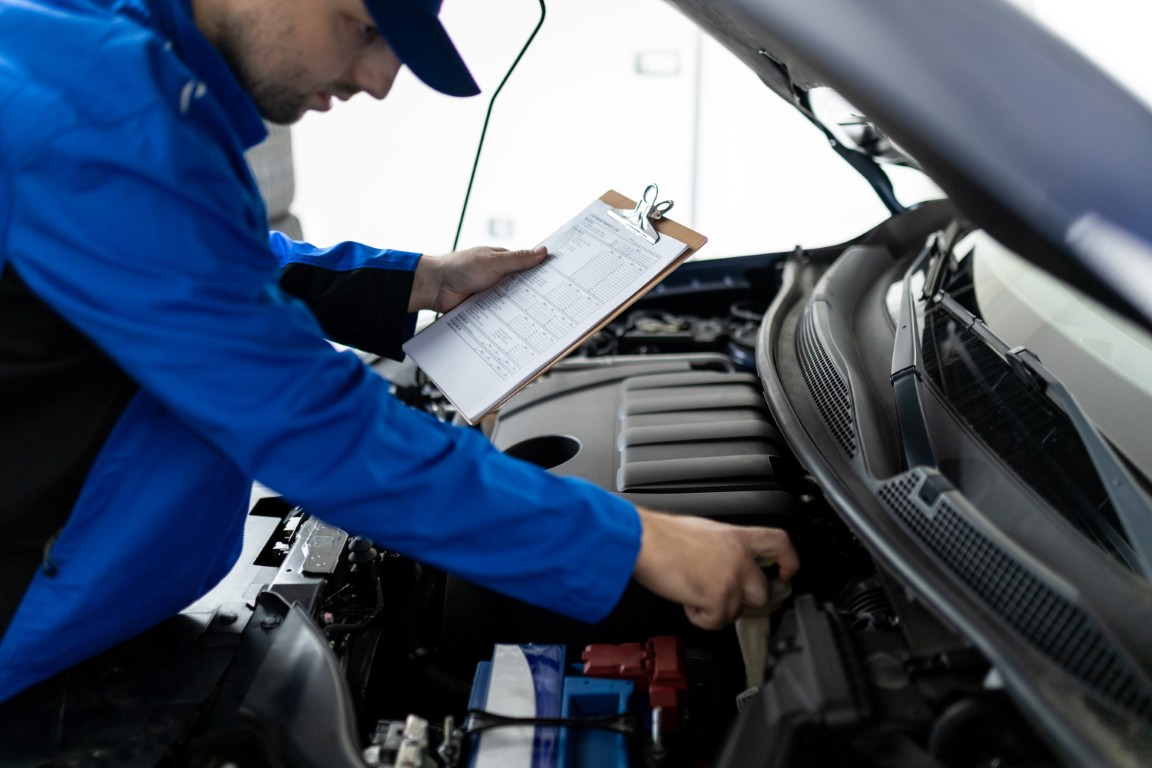
When we take the wheels off, we measure the pad on both sides of the rotor, because they often wear at different rates and the inner one is the one you can never see. We measure how much thickness the rotors have left against the manufacturer’s minimum, and check them for scoring, heat damage, and warping.
We also check the sliding hardware the brake assembly rides on. When that sticks, one pad does most of the work and wears out fast while the other barely wears at all. Replacing pads without fixing that means you’re back here in a few months.
Then we look at the rubber brake lines for cracking or bulging, inspect the metal lines for rust, and check the parking brake adjustment. Brakes are one of the areas where doing the whole job properly costs a little more today and considerably less over time.
Don’t wait for the noise to get worse
Brakes give you plenty of warning, and that squeal is your window. If you’re hearing it now, you have time to schedule the work when it suits you rather than discovering the problem on a wet road in November.
If your car is due, or if something just feels different than it used to, bring it by. Our complimentary inspection includes a brake check, and you’ll get a straight answer about how much life is left.
Schedule Your Service at Franklin Automotive
Franklin Automotive has served Franklin, Brentwood, Cool Springs, Spring Hill, Columbia, and Leiper’s Fork since 1999. We’re a family-owned NAPA AutoCare Center with ASE-certified technicians, and every qualifying repair is backed by our 3-year / 36,000-mile warranty. We also offer a free shuttle and complimentary inspections.
Call (615) 472-8052 or visit us at 307 5th Ave N, Franklin, TN 37064. We’re open Monday through Friday, 7:00 AM to 5:00 PM.