
It’s one fluid doing two jobs. In summer it carries heat away from the engine so nothing overheats. In winter it keeps the water inside your engine from freezing and cracking the block. Coolant and antifreeze are the same thing, named for whichever job you happen to be worried about.
Fall is when checking it makes the most sense, because a coolant problem that was merely inconvenient in summer becomes genuinely destructive once temperatures drop below freezing.
What happens if the mixture is wrong
Coolant is meant to be a mix, usually about half coolant and half water. That combination protects your engine well past any cold Middle Tennessee is going to throw at it. But the mixture drifts over time, and there’s one common way it happens.
Somebody runs low in July, adds plain water to get home, and never gets it corrected. Now the mix is watered down. The freezing protection is weaker than it should be, and plain water offers no protection against rust and corrosion at all.
Water expands when it freezes, and it does so with tremendous force. Enough force to crack an engine block or split a radiator, which is one of the more expensive things that can happen to a car. It’s also entirely preventable with a fluid test that takes about a minute.
Coolant wears out even when nothing leaks
There’s more in that jug than colored water. Coolant contains additives that protect the metal, rubber, and gaskets it flows past. Those additives get used up over the years, and once they’re gone the coolant stops protecting those parts and starts slowly eating away at them instead.
That damage happens quietly, and you usually find out when something begins to leak.
The easiest check is color. Healthy coolant is bright and clear, whether it’s green, orange, pink, or yellow depending on what your car uses. If yours looks rusty, muddy, or has bits floating in it, it’s broken down and doing harm rather than good.
One thing worth having a professional handle: coolant types are not interchangeable. Different formulas can react badly with each other and turn into a sludge that clogs the system. If someone has topped yours off with whatever was on the shelf at the parts store, we should check what’s actually in there before it causes a problem.
The whole system deserves a look
Checking fluid condition is the starting point, not the whole job.
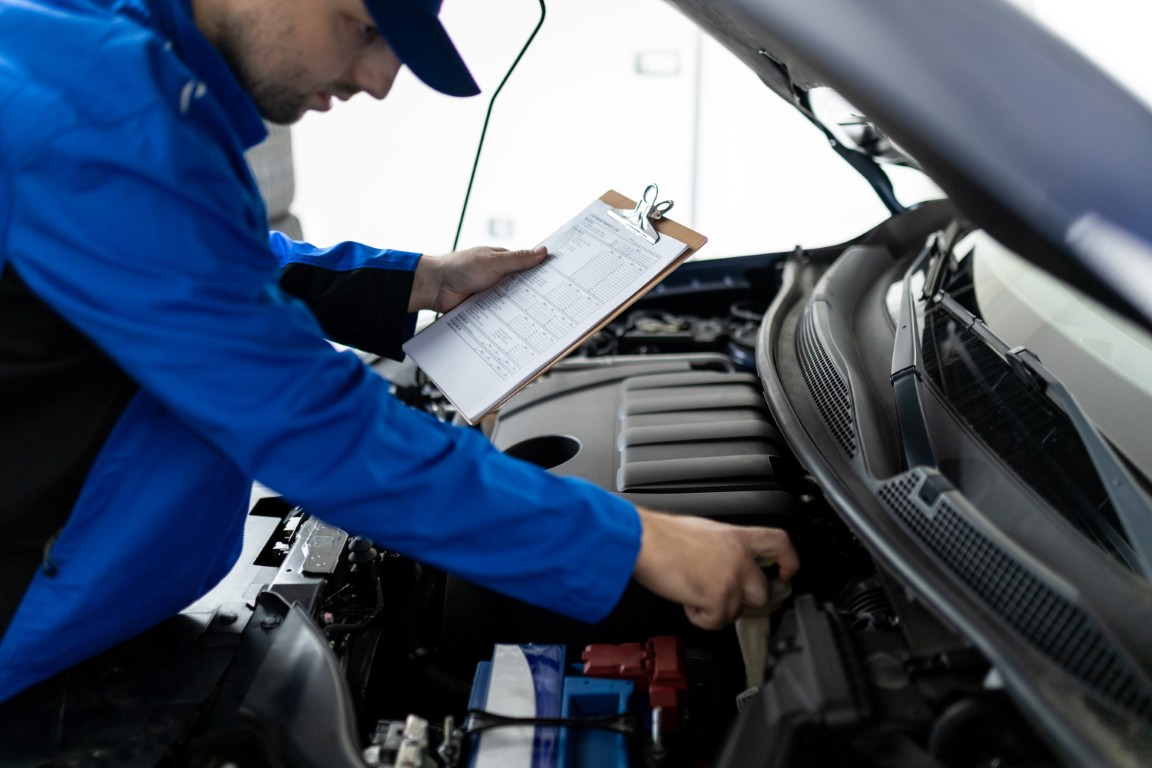
We pressure test the system, which means putting the cooling system under pressure while the engine is cold to reveal leaks that hide when nothing is flowing. We check the radiator cap, which is a small inexpensive part that holds the whole system at the right pressure and fails more often than people expect. We look at the water pump for signs of seepage. And we make sure the thermostat is opening and closing when it should.
That thermostat is a small valve that decides when coolant flows to the radiator. Stuck open, your engine never fully warms up, which hurts your gas mileage and adds wear. Stuck closed, it overheats you. Both are common and both get more noticeable in cold weather.
Warning signs
Keep an eye on your temperature gauge and note if it settles anywhere other than where it normally does. Look for orange, green, or pink puddles under the front of the car, which are coolant rather than water. And if your heater starts blowing cooler than it used to, that can be an early sign the coolant level has dropped, which we go into further in our post on testing your heat before winter.
Read more: Test Your Heat Now, Not on the First Cold Morning
Get it tested before the first freeze
A coolant check is quick and it’s part of our complimentary inspection. If the mixture is off or the fluid is past its life, flushing and refilling it is a modest job. Replacing a cracked engine block is not.
Schedule Your Service at Franklin Automotive
Franklin Automotive has served Franklin, Brentwood, Cool Springs, Spring Hill, Columbia, and Leiper’s Fork since 1999. We’re a family-owned NAPA AutoCare Center with ASE-certified technicians, and every qualifying repair is backed by our 3-year / 36,000-mile warranty. We also offer a free shuttle and complimentary inspections.
Call (615) 472-8052 or visit us at 307 5th Ave N, Franklin, TN 37064. We’re open Monday through Friday, 7:00 AM to 5:00 PM.